Saturday, February 27, 2016

Week in Film #8: 2/15/16-2/21/16

Week in Film #8: 2/15/16-2/21/16


Film of the Week: The 400 Blows
   Year: 1959
   Director: Francois Truffaut

       And so Francois Truffaut helped to usher in the French new wave cinema with one of its crowning achievements. Possibly the definitive coming of age tale, this one has a heart that beats, and the rare ability to show that heart without exploiting it. The pain Antoine feels is our pain because we understand it, and we understand him. When you really look at it, he is sort of a little trouble maker, but you can tell where he comes from. Film is the great empathy machine, and it can make you connect with those who are outside your age, among other various sorts of things, like culture, or social class.

       Antoine is cast perfectly, Jean-Pierre Leaud filling the role with a stony solemness that is equally balanced by a boyishness and youth. The actor seems old beyond his years, but also clearly in the throws of adolescence. Its an odd pairing that pays of spectacularly, and I doubt if Truffaut could have found a better actor to play the part. In fact there doesn't seem to be a poorly cast part in the whole movie. Antoine's mother is believable and realistic, his step father showing a kindness of more friendliness than parental connection, his teacher suitably harsh and temperamental. It's almost a perfect storm on all fronts, from direction to acting to cinematography to score.

       I think probably more than any film I've seen this understands and empathizes with the harsh and painfully emotional world of childhood. Many films have captured the spirit of adolescence, from The Breakfast Club to Boyhood, but I don't think any of them can match this in its sheer presence. It feels like growing up does: Joyous. Exuberant. Confusing. Melancholy. Lost. It captures and bottles that feeling of not knowing the way, of that intangible feeling that comes with growing pains. something so hard to define and so hard to find, making it all the more impressive that Truffaut was able to portray it on the screen. The ending is the most evocative of this feeling. It is a perfect visual representation of that obscure feeling that is almost forgotten when we grow out of it. This movie is a memory, the audiences own memory, recalling something that was once felt and lived.

   Rating: A

The Rest: 

Le Havre
   Year: 2011
   Director: Aki Kaurismaki 

       A happy and warm hearted work. Its nice in an age dominated by cynical perspectives to have something of such decent humanity and compassion, without being overblown or sappy. There is some influence from 50s melodrama here, with noir lighting at times and possibly a touch of Tati. It tackles relevant societal issues with a poignant humanism that is both funny and touching. 

   Rating: B

The Long Goodbye
   Year: 1973
   Director: Robert Altman

        It's hard to pin down exactly what makes an Altman film an Altman film. All I know is I know one when I see one. Maybe its the slight zoom thing he does, or his focus on subject matter of the American social landscape, or his sense of characters. Whatever it is it works well, and this is no exception.

   Rating: B+

Shoot the Piano Player
   Year: 1960
   Director: Francois Truffaut

       The only exposure to Truffaut I'd had before this was a few years ago when I saw The 400 Blows (something I remember liking) and Jules and Jim (something I remember hating), but I don't think I was at a maturity to fully appreciate that sort of artistic film. So seeing this is sort of a first impression of sorts of the director, and going off this, one thing is already clear: he is completely infatuated with film. Cinema as a medium of expression and as an art form, as well as just a device made for capturing and performing feeling. He is a filmmaker with a great sense of style and movie making in general, and it shows in his composition, pacing, and all around direction of this magnificently filmed noir. It is made with a confident grip on the craft at hand, showing that Truffaut is virtuoso auteur who knows how to wield a camera to evoke that intangible feeling of cinema itself.

   Rating: B+

WR: Mysteries of the Organism
   Year: 1971
   Director: Dusan Makavejev

       I really have no idea how to rate this. In fact, I'm not even sure what it is I just saw. I don't know if it was awe, or just confusion. Most likely somewhere in between. I don't think it can really be judged fairly by my traditional A-F grading system, because it simply defies proper analysis, as much as it defies categorization or even articulation. Part documentary, part phony propaganda, part musical, part pornography, and, I think, all comedy, as well as a few other things. This is the kind of comedy however that isn't so much laugh out loud, mostly because your jaw is on the floor for much of the viewing, either in something like shock or confusion, but more the kind that hits you on a sort of intellectual plane, or an emotional one. It's humor stems from its absurdity, which is so unique that it is hard to define or describe, but can be called surreal definitely. Is it any good though? Yes, it may even be a masterpiece. Then again, maybe its nowhere near. This is less a review and more a reaction, but this film is less a film and more of a happening, so it seems appropriate.

   Rating: B+

Code Unknown: Incomplete Tales of Several Journeys
   Year: 2000
   Director: Michael Haneke

       What an apt title. Especially the "unknown" and "incomplete" parts. It's a series of loosely connected vignettes, most all of which are single takes, focusing one a few different characters and their lives, sometimes intersecting. This is not an easy film to watch, partly because of its depth, mostly because of its unrelenting bleakness. It almost feels worth it, but in the end anything I feel I may have gotten out of it is overshadowed by its weight. It may have been the mood I was in, but I had a hard time finding that connection to the screen that is vital in movie going experiences. I just wasn't in to it. But I've been thinking about it sense I saw it (last night) and part of me feels I should give it another chance. Anything that can stick with you is probably worth something. Maybe a few years down the line I'll revisit this, and hopefully get into it a little more.

   Rating: C+

A Generation
   Year: 1955
   Director: Andrzej Wajda

       The movie is mostly fine, and primarily throwaway and unexceptional, accept for one sequence that is pretty damn impressive compared to the rest of the film. The sequence in question is the murder/suicide of one of the main underground freedom fighters of a revolt against the Nazis in Warsaw, which features a series of great shots and realistic and surprisingly unique use of bullet impacts, both on objects and an arm. Unfortunately the rest doesn't match this quality. It isn't bad, it's just sort of fine. Nothing special, nothing particularly outstanding, just an everyday wartime drama.

   Rating: C

Closely Watched Trains
   Year: 1966
   Director: Jiri Menzel

       I thought of Wes Anderson while watching this. It has the same gentle innocence, reminiscent visual style (albeit in black and white), and thorough sense of humor. This has that, but also a much darker sense to it as well compared to Anderson's work. The young protagonist exists like much young people do: completely absorbed in their own world, while bigger things go rushing by like trains. Its a coming of age tale that ultimately reaches a conclusion that is a encompassing symbol for boys who came of age in the battles of World War II. Fighting, rather standing by ready, as the generals and commanders determine the direction the world takes. Caught in the crossfire and barely even knowing it as the world moves around them. There are more important things on the mind of an adolescent boy.

   Rating: A-

Bridge of Spies
   Year: 2015
   Director: Steven Spielberg

       A sign of a good director is his ability to effectively manipulate the audience into feeling a certain emotion. A sign of a great director is his ability to do it without the audience realizing it. Spielberg is, for me, a good director. At least when he's not making masterpieces such as Jaws and Schindler's List. Which makes it all the more disappointing when I see him directing a movie like this one: solid, but ultimately cliche and overtly sentimental. I know he has it in his power to pull real, profound emotion from somewhere other than John Williams ever present and overbearing score, or from the library of cinematic techniques to grab easy schmaltz in place of something that is more earned. This works fine, I guess, but for the most part I find myself rolling my eyes at dramatic speeches meant to move me, that I can't connect with because of the unshakable aura of faked feeling that pervades through the air in such scenes. It just doesn't feel real to me.

   Rating: C

Room
   Year: 2015
   Director: Lenny Abrahamson

       In contrast to Bridge of Spies, this is something that, for the most part, earns it's emotional moments. It could be said that the very premise warrants such emotional pull, but it is in the delicate execution as much as it is the subject matter. It uses a gentle, yet powerful touch to tell a hard story. The best thing about this one is Brie Larson, who no doubt will win the Oscar for an amazing display of powerful acting.

   Rating: B

Mad Max: Fury Road
   Year: 2015
   Director: George Miller

       The symphony of anarchism as conducted by George Miller.
This is not an easy affair. It is fast, brutal, unrelenting, and so packed with adrenaline and action that it risks capsizing and throwing the entire production overboard. Magically, somehow, Miller is able to pull this all together and deliver one of the tightest, most furious, most chaotic, most visceral action films I've ever seen. And more impressively, it all adds up to something far more than the sum of its parts: a wild enthralling call of feminism in major motion pictures, a study of masculinity in a male dominated world, and an indictment of religious extremism, that also manages to humanize even the most malicious and brainwashed of offenders. A real masterpiece of fury and flame.

   Rating: B+

The Big Short
   Year: 2015
   Director: Adam McKay

       Who ever thought you could make economics so damn fun and engrossing. While I'm not afraid to admit some of it went over my head, I feel I understood more about the American economy than I ever have in regular conversation, or in other films for that matter. The use of meta style fourth wall breaking moviemaking and unique structure make something that could be incredibly dull into something that is easily digestible. By making it interesting, it makes it easier to understand, and by understanding it better it is easier to see how fucked up the whole thing was back in 2008. I was too young to really know what was going on, but I do remember that something was happening. I never really knew the full scope of the recession until after this, and I have to say it left me pretty shocked.

   Rating: B+

Monday, February 15, 2016

Week in Film #7: 2/8/16-2/14/16


Week in Film #7: 2/8/16-2/14/16

Film of the Week: The Cook, the Thief, His Wife and Her Lover
   Year: 1989
   Director: Peter Greenaway

       Peter Greenaway crafts disguises, often barely hanging on, and then strips it off to show the rotten flesh beneath. The stench of decay masked by odorous perfume. What happens when the make up comes off? Nothing nice and nothing pretty. That is, from the little I've seen, my impression how most of his movies play out. This explores these themes too, but it doesn't bother to dress itself up much in the first place. Sure it may involve fancy outfits and fine dining, but in its opening moments its clear that there isn't going to be many delusions about the moral rot in these peoples cores. It's bite is clear as soon as it begins.

       This is an experience that outdoes A Clockwork Orange in it's depiction of violence and depravity, and does it while outdoing Tarantino in it's incredible style and catharsis of it's revenge sequences (not to say the styles are much comparable). It is, in it's essence, a pretty sick film. We have everything here from mutilation to cannibalism, all of which is presented rather graphically, but never gratuitously. It is hard to watch at times, but you keep watching because of its beauty; beauty which is often most apparent in it's images of violence. But the most beautiful seems come from the moments of tenderness and passion in between. The mercy contrasts starkly with the unrelenting brutality, making instances of humanity all the more impactful. And the brutality is beyond humanity itself, but also, in a way, encompassing and expressive of it. It is human in its primal anger and rabid jealousy, its fits of uncontainable rage and excessive aggression. It isn't the pretty side, but it is as human as the lovers embrace that is often interrupted by the said darkness.

       The most obvious of the major achievements in the film is its production. The colors and sets are absolutely gorgeous, taking on the image of the best stage sets ever crafted. The whole movie it seems is a play, much like others I've seen from Greenaway, specifically Nightwatching. The camera drifts from stage to stage watching the performers play out a dramatic tale of pain and love. The sets pop with reds that engulf the world of gangsters and their prey: blood, wallpaper, meat, and curtains. Red pervades throughout the movie and seems to envelop all in its meanings of violence and passion. Places like the white decor of the restroom and threatened by the red light of the restaurant when the door is opened. Danger is always right behind the door, and that may be why the connection between the wife and her lover is filled with so much passion. They are of the same color.

   Rating: A

The Rest: 

Ordinary People
   Year: 1980
   Director: Robert Redford

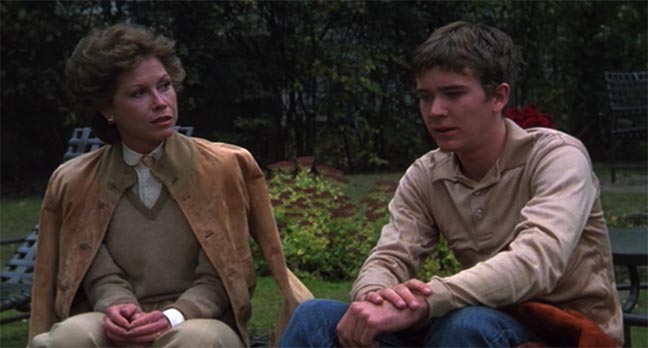
       I went in wondering how anything could possibly beat Raging Bull as best picture of 1980, and I left still thinking the same way. However, this is certainly less insulting than say Kramer vs. Kramer beating Apocalypse Now, not to say that Kramer vs. Kramer is a bad movie, it just isn't the masterpiece the other is. Ordinary People is different than the undeserving winner of that year in that it is more than a good movie, it is a very good one, possibly even great. And it isn't fair to compare it to something so masterful as Scorsese's losing picture of that year, even though they were in the same category. It could be argued that it is unfair to compare any movie to any other, but it is almost involuntary, it is just the way the mind works, to rank and order. At least my mind anyhow, and the minds of countless other list makers and categorizers. Part of me feels it's unfair though. Why should I have a lesser opinion of a film as strong as this just because it beat something even stronger to the Oscar, an award that is essentially meaningless when it comes to appreciating the art of a film. This is a movie that deserves praise, and it is one made with enough art and emotion to warrant a best picture. That is if it weren't competing against possibly the best film of the 80's full stop.

   Rating: B+

The Draughtsman's Contract
   Year: 1982
   Director: Peter Greenaway

       Not as strong as The Cook, the Thief, His Wife and Her Lover, but still pretty good in its own right. It has similar themes, specifically the dressed up depravity of the upper classes, and it plays it out well, and with style and point precision. Wonderful shots and extravagant wigs galore, it is, like a Greenaway film, with an air of a play about it. The compositions and staging make it feel as though your watching theatre performed on the biggest stage ever constructed, one that is visible from all angles and as expansive as an estate. Beautiful greenery and plotting involving murder and intrigue.

   Rating: B

Pumpkin
   Year: 2002
   Director: Anthony Abrams and Adam Larson Broder

       One of the great, appallingly misunderstood comedies of the modern age. This may be because it is satire so raw, so pure that it likely went over the heads of many critics at the time. It may also be because the movie takes no prisoners, and isn't afraid to pole vault over the line between political correctness and the taboo realm of our society. The most remarkable thing this movie does is, at least until the very end, refuses to wink at the audience. It gives no easy way out, and any gesture that the film is only kidding. It is absolutely serious, or pretends to be, and it is as unnerving as it is hilarious. There is not a trace of bullshit in this film. No punches are pulled, and that makes it more comically powerful. In the guise of a world of plastic schmaltzy fakery, it is able to say the most brutally honest things about the state of the culture we live in.

   Rating: B+

Shadows
   Year: 1959
   Director: John Cassavetes

       It crackles with amateurism (not necessarily in a bad way) and realism that ends up being a little too unpolished to have too much of an effect on me personally. I can see its importance and the affect it must have had back in its time, but independent cinema would be much better made later, often by Cassavetes himself. This isn't to say it feels aged, it actually very much seems ahead of it's time, and remarkably fresh. An important film in it's vision, but a scratchy and unfinished piece of work, feeling like its lacking some part of it, not quite whole.

   Rating: C

A Hard Day's Night
   Year: 1964
   Director: Richard Lester

       The best way to describe A Hard Day's Night is fun. It doesn't aim to be anything more and it achieves nothing less. It doesn't even strive for any kind of story, really being just the Beatles strung together by various gags and songs. This isn't a complaint so much as an observation, because the movie doesn't try to be more than it is, which is a filmic vessel for the Beatles to present their craft and garner more fuel for the skyrocketing popularity of Beatlemania. It doe its job well and presents the fab four as fun loving, care free youngsters with a whole lot of charm and great music. Good fun is what it is, and it should be judged by the standards brought with that description.

   Rating: B-

Help!
   Year: 1965
   Director: Richard Lester

       Playing like a wackier version of A Hard Day's Night, the effect that is made by this is a step below that of the former. It has the same sense of humor, essentially, but lacks the pure energy that made the better Beatles film work. Also the pacing is all over the place and it just gets too silly to be much. The coolest thing for me was the probably unintentional foreshadowing of eastern religions and music that would very soon come into the world of the Beatles, and would be a major factor in changing the face of popular music forever.

   Rating: C-

Creed
   Year: 2015
   Director: Ryan Coogler

       The most satisfying thing Creed does is what Michael B. Jordan's titular character attempts to achieve for himself: building it's own legacy. And it does it, like Adonis does, by borrowing from its past. This is most evident in the use of the classic Rocky score, which is used perfectly and hardly at all, only in one or two moments where it feels appropriate. This films biggest victory is beginning its own legacy. It just remains to be seen if it follows through on that, which is something that it doesn't need to do, but something that could be done with a strong basis such as this.

   Rating: B-

It Happened One Night
   Year: 1934
   Director: Frank Capra

       It Happened One Night is about a woman who escapes her fathers controlling, overbearing ownership, only to fall into the arms of a man who wishes to control what she does in much the same way. It may pretend to be about liberating a woman from her fathers control, but it is still about men dominating women in the end. That out of the way, it is also a very enjoyable, surprisingly funny romantic comedy road trip movie that is very well made and hasn't lost any spark from when it first premiered over eighty years ago. It really is miraculous how well it holds up over such a long period of time. A very nice example of the charms of old hollywood, apart from the blatant sexism that is.

   Rating: B

Monday, February 8, 2016

Week in Film #6: 2/1/16-2/7/16

Week in Film #6: 2/1/16-2/7/16

Film of the Week: The Life and Death of Colonel Blimp
   Year: 1943
   Director: Michael Powell and Emeric Pressburger

       The movie starts with, after a chase, an old army man berating a young officer, and then beating him, for his insolence and impudence. The moment flash's back without a cut or dissolve, and we see the old man as the young man was: full of life and energy and a bit of naivety and the strengths and weaknesses of youth. The rest of the story is told linearly, but this is an important exception, one that tells the entire story, from a perspective, in it's first five minutes. The story of the clash of generations, and of the wisdom and anti-wisdom that one acquires. About the old way versus the new one, the past and the present, antiquity and modernism. Not a clash of ages, per say, but a clash of ideals, ones that may fluctuate over time. The proper way, as Colonel Candy sees it, and the easy way, probably the more productive, but maybe not the right.

       This is a take down of British Victorian ideals about gentleman-ship and respectful austerity and manners, but it is also clear that the pair of directors have a love for the very institutionalism that they proceed to, albeit very respectfully, tear down. It's not that they totally want to destroy this form of British values, but they want to point out its flaws and its ridiculousness, at the same time embracing it, in an arms length sort of way. Aside from all the political insinuations, the look and feel of the film is one so steeped in Englishness it makes you feel a nostalgia of sorts for it, a comfortability with itself. There is a great fondness for the outdated ways of old, one that looks back in admiration, but also caution and amusement.

       Roger Livesey is great, showing believable aging process both physically and characteristically, and doing so on par with Orson Welles in Citizen Kane. In his youth he brings a liveliness not without respect and dignity, and in his older days a regalness and still beating spirit. It's an outstanding and detailed performance, and one that should be acknowledged as a great one. The grandeur of production evokes David Lean at times, and the signature use of color and its sheer perfection of composition gives it a a grand and all around impressive feel. This is a movie of vastness, in its character, its imagery, its themes, its scope, and its production. One that says important things, while being about a single man, and saying it in personal and heart rendered ways.

   Rating: B+

The Rest:

The Bad Sleep Well
   Year: 1960
   Director: Akira Kurosawa

       It is commonly said that all serious actors at some point come to Hamlet. In Kurosawa's very loose adaptation of the bard's play, it is Toshiro Mifune who plays the avenging son. Mifune is straight and clean cut, all buried rage and passion. It may be very liberated from the source material, but the film captures the spirit of the play and applies it to the modern era of corporate greed and corruption; corruption so deep it even ensnares the stand in for the ghost of the princes father. It's an effective translation, but the movie itself suffers from tonal imbalances in places, odd moments of comedy or lightheartedness that simply do not fit in with the noir grit and dark overtones of the picture. However, this doesn't ruin Kurosawa's overall impeccable sense of style and composition, making it nearly as well crafted a piece of cinema as the others I've seen from the Japanese auteur.

   Rating: B-

All That Jazz
   Year: 1979
   Director: Bob Fosse

       Encompassing all the glitz and glam of showbiz, it garners that image and energy to lament the lifestyle its lead lives, and the destructive powers of artistic obsession and personal recklessness. I've seen a lot of movies lately that tackle the topic of the drive that comes with the want to create art and the issues that arrive and ensnare the artist on his quest for that creation, or performance. The others didn't get as meta about it as this one does. Stepping out of itself in more than one way, it also immerses itself in the world of performance art, and performance in it's own right, just as much. And it all does it with well crafted, electric editing and all out presentation, particularly in its ostentatiously outstanding finale. 

   Rating: B+

Mouchette
   Year: 1967
   Director: Robert Bresson

       When Mouchettes world is finally her own, there seems to be the sound of guns to break the silence. You get knocked down until you can't get back up again, no matter how many times you've picked yourself up before. Like all Bresson I've seen thus far, the themes and approach is handled with forwardness and muted emotion. Things are simply presented to you, not necessarily advising you or even manipulating you into feeling a certain way about them. You would think that this gives off cold and distant vibes, but it somehow actually makes the opposite occur. It is more emotional and powerful because instead of letting feelings explode, the silently seep out, and it makes for the kind of longing painful sorrow that can't be achieved through the flash and dance another filmmaker might have brought to the film.

   Rating: B

Hail, Caesar!
   Year: 2016
   Director: Joel and Ethan Coen

       Hail, Caesar! in it's structure is much like that of the the world of Eddie Mannix: disjointed, hectic, and constantly interesting. This approach on the one hand lends itself well to the Coen's vision of various vignettes of the Hollywood studio system of yonder tied together by an overarching communist threat, which is very appropriate to the time period. On the other hand, it feels a little broken up and sometimes meandering and without a flow. That is somewhat beside the point when the rest of what goes on is so hilariously spot on Coen Brothers style and wit. A combination of their signature mix of surreal comedy and surprising moments of slapstick make this incredibly funny at times, often in the most amazing and unexpected ways, as you learn to expect with their movies. Overall worthwhile, but not their best effort.

   Rating: B-

Charulata
   Year: 1964
   Director: Satyajit Ray

       This is something that lulls you, into a trance state of sorts, and fully envelops around you. One of those movies that takes you in, and brings you right into the lives of the characters. Beautiful on more than an aesthetic level, as Rays films tend to be, showing the very essence of life, the rhythm and flow of the world. Take the absolutely stunning sequence on the swing, where the camera follows Madhabi Mukherjees face as she glides back and forth, upwards and back down on the seat. It's somewhat simple, but incredibly effective, and not like anything I'd seen before on film. Enchanting, as is our lead actress, the sensitive humanity of the story, and the movie itself.

   Rating: A-

Grand Canyon
   Year: 1991
   Director: Lawrence Kasdan

       It's fine. Decent performances, moral messages, standard contrivances somewhat balanced by moments of truth, however small. It's commentary on race isn't explored the way it could have been, and its perspective is more or less safe and traditional. The whole thing is rather traditional, which wouldn't bother me I suppose if I hadn't been exposed to so much inventive, impressive, original, and great cinema as of late.

   Rating: C+

Monday, February 1, 2016

Week in Film #5: 1/25/16-1/31/16


Week in Film #5: 1/25/16-1/31/16

Film of the Week:
2016 Oscar Nominated Short Films

 
   Documentary: 
       Overall this year features a strong group of nominees, three of which are very good. The least effective of the group is "Claude Lanzmann: Specters of Shoah", which despite this will likely win due to it's subject matter. If anything it made me curious to actually see Shoah. The other lesser effort is Body Team 12, which is good enough but suffers from a lack of material and being too short to hold ground with the rest of the nominees. Tied for first place are Last Day of Freedom, an inventive use of animation that makes this the most unique of the bunch, Girl in the River: The Price of Forgiveness, which inspires much anger towards a broken society and raises awareness of troubles that affect other areas of the world, and Chau, Beyond the Lines, which is an inspiring and uplifting short about a subject I previously knew nothing About. If I were to pick one, I would choose Chau, for it's ability to make me smile despite it's sometimes painful subject matter and it's optimistic approach and likable main character.

   Animated: 
       Aside from one standout, the lineup of animated shorts this year is sort of just fine. The animation itself throughout is strong and inventive, but most of the stories are lacking, and come across as just standard fare. While Sanjay's Super Team should be commended for taking on the topic of a non-western religion, it is pretty much a uniform pixar entry, with nothing very new or impressive to add. Bear Story is, I think, a metaphor for the Holocaust, and has the emotional pull that you'd expect. Or at least attempts the emotional pull, I myself wasn't particularly affected. We Can't Live Without Cosmos is at times funny, and the animation is well designed, but ultimately like most of the nominees simply couldn't grab me in the way it wanted to. Possibly the biggest achievement in sheer animation is Prologue, which features beautiful hand drawn illustrations of battle and carnage. Far and away the best of these is World of Tomorrow, which is simplistic but wonderful in it's animation and has the humor and surprising emotion to pull of it's odd style. This should win, but I have a feeling it will lose to one of the more traditional entries.

   Live Action: 
       This is quite the grim set of shorts this year. Aside from Ave Maria, these range from melancholic to down right morbid. Ave Maria is the lightest of the nominees, as I've already stated, and provides a nice breath from all the doom and gloom, or it would have if I hadn't seen it before the others. It's funny and enjoyable. The second lightest in tone is Stutterer, which only really gets that merit based on the happy ending, the more eased topic compared to the others. None the less it is effective and well crafted. Everything Will Be Okay is a pretty heartbreaking story of loss and love for a child, and one that wounds in an emotional way. Shok is probably the most pessimistic and emotionally brutal one, and if you are able to withstand the painful feelings it is rewarding. Although I do feel like I see this film in some form every year I do this. Lastly and in my opinion the best is Day One, which is the most shocking, and also the most hopeful of the three truly depressing shorts. It balances the emotions well and is the most even and affective of the category.


The Rest: 

The Earrings of Madame de...
   Year: 1953
   Director: Max Ophuls

       It's odd how sometimes the smallest things in life can carry so much meaning to us. That can often be a source of misplaced affection and eventual misfortune, as Madame de... learns. The film displays the upper class pristine life of a woman so incredibly proper and ornamental that at first I mistook it for satire. After a while though I came to realize that the movie was being very serious, and that is also where I was able to connect to it on a human level. It takes considerable skill to feel touched by the laughably ornate and seemly romantic entrapments of the most decadently wealthy and materialistic people I've ever seen. But the skill and craft is so good that it draws you into the feelings of these people with incredible ease and confidence. The camera work is on another level. The dancing scenes are like magic in their mobility and effortlessly elegant movement, the camera simply gliding and floating with precision and a looseness that makes you forget that there even is a camera. Masterful filmmaking here.

   Rating: A-

Blackboard Jungle
   Year: 1955
   Director: Richard Brooks

       I thought my school had bad kids, but at least none of them attempted to rape a teacher, as far as I know. As far as good teacher vs. troublesome class films go this is pretty good, with excellent naturalistic performances, especially from Glenn Ford and Sidney Poitier. Some have called it dated, but I found it pretty relevant in aspects to my high school experience. Clearly daring for it's time, which it should definitely be praised for.

   Rating: B-

The Red Shoes
   Year: 1948
   Director: Michael Powell and Emeric Pressburger

       Technicolor never looked to awe-inspiringly gorgeous as it does in the films of Michael Powell and Emeric Pressburger. The color pallet is truly beautiful and is visually unlike anything. The Red Shoes sequence in particular is astounding in it's vision and beauty, with technological brilliance and cinematic magic that is simply amazing. It is also as good a portrayal of artistic obsession and drive as I've ever seen. The cast throughout is on top form, and the movie is rightly deemed a masterpiece.

   Rating: A-

Black Moon
   Year: 1975
   Director: Louis Malle

       Surrealism and strange happenings are some of my favorite things that can happen in the movies. However, this is when and if they work. Unfortunately, for the most part, this is the case in Black Moon. Everything feels repetitive and honestly pointless, taking interesting little moments that would work well tucked into another film, instead of making the entire film out of those moments. The cover for the criterion edition of the film evokes rorschach tests, implying that the film is open for interpretation, and whatever you see in it is what the film means to you. For me, I saw something that resembled a director throwing bits together to try and create the semblance of meaning, but falling short and producing something of a mess.

   Rating: D

Wednesday, January 27, 2016

Week in Film #4: 1/18/16-1/24/16


Week in Film #4: 1/18/16-1/24/16


Film of the Week: Floating Weeds
   Year: 1959
   Director: Yasujiro Ozu

       Yasujiro Ozu is one of the truly unique voices in the movies. He's the kind of filmmaker who's individuality is in a different realm than others. Yes, many directors, from Kurosawa to Scorsese have a very distinct voice, but you can see influences and similarities connected to others. Ozu seems to have approached film almost as if he had never seen a movie before. That may seem like hyperbole, but there is something so incredibly original in the way he directs: his framing, his style, his tempo, his control. You might mistake the right samurai film for a Kurosawa, or a certain stylish gangster film for a Scorsese, but you wouldn't ever be confused over whether a film is an Ozu. It's a special kind of originality that is somewhat rare in cinema. Where you look at something and can be certain no one else could have made it.

       Every single shot, every single frame is perfect. With his distinct style, Ozu is able to capture the beauty and intimacy of life, and doing it with such laid back ease and patience that it seems natural and real. Real on an emotional level, not necessarily an aesthetic one, as the compositions are too meticulously perfected and the performances very restrained. It's not really in visual or the story that gives it a feeling of life, but what bleeds through in the craft of it's delivery. It's hard to explain, but it's as if Ozu has taken something that is made with artificial precision and very careful composure, and somehow made it warm and human, even nostalgic. It's power lies in it's restraint, where other directors would go for climax. By centering his characters directly in a frame he is able to create a sort of intimacy by having the characters talking directly to the camera when speaking to each other, something that feels like it shouldn't work, but somehow does.

       Using simple and uncluttered filmmaking well suits the basic theme of Ozu's filmography: family. An admirable aspect of the film is it's refusal to take sides. It simply portrays it's characters as they are, and it lets all sides of the story be brought into view. It is able to sympathize with it's young characters and its old, its men and its women, and this gives at a well rounded, multilayered, but fundamentally basic feeling. It's simple, but in an elegant, beautiful way. For the most part big drama is put to the side and the players act how they would, giving honest responses and actions. Ozu has been known to liken himself to a tofu maker, but I see him as much as a painter of films. He paints pictures of family and often times homeliness and comfortability, with deep compassion and understaning.

   Rating: A-

The Rest:

The Tale of Zatoichi Continues
   Year: 1962
   Director: Kazuo Mori

       This is pretty disappointing after the excellence of the first in the series. It is odd when a movie simultaneously does very little and tries to do too much. For some reason, Zatoichi feels an enormous debt to a samurai he met twice or so and then killed, so a year after their final confrontation he revisits his apparent great friends grave to pay his respects. This is, again, miraculously, of great emotional strain to him. Also a billion other things happened since the last film, including him falling in love, being dumped, dismembering the guy his ex left him for, and the beginning of a strong resentment that pays off in this film. Except it isn't a pay off because we have no relation what-so-ever to any of these events, and therefore have no reason to care about any of it.

   Rating: D+

The Ice Storm
   Year: 1997
   Director: Ang Lee

       It's more than just the winter that's cold, it's the distance between people, and the disconnect that happens in families and homes. But warm hearts and warm desires glow from within, giving brief spots of humanity and wonder to an otherwise frozen over world. And these things run deep throughout this movie. With subtleness and a delicate hand, Lee fashions a growing up tale for some, and a growing old tale for others. 

   Rating: B

Every Man for Himself
   Year: 1980
   Director: Jean-Luc Godard

       Theres an air about this film of a director who is, essentially, throwing whatever he can together into some incomprehensible and unnecessary collage of pretentious fabrication, hoping that his "profound" meditations on something or rather pull together into some sort of cohesive whole. But god dammit if Godard doesn't do it with hypnotic, cinematic style. It may be grasping for straws in it's attempt at finding a meaning, and one is decipherable I'm sure, it just seems so ostentatious. There is no doubt however that Godard knows what he's doing cinematically, and I can't say I was ever bored during this.

   Rating: C

Sullivan's Travels
   Year: 1941
   Director: Preston Sturges

       What this does is something very unexpected and very honest about things such as privilege, and works as a fine moral as well. Sturges has the sense and self awareness to mock himself at others like him who try to make "serious" pictures, as if they truly know a thing about suffering. And he goes further by proving how phony this is by having his stand in try to understand this, and come back with a false sense of empathy for people who have felt a hundred times the pain he thinks he's endured in his very brief venture into poverty. That is until he is mistaken for someone else and put to work on a chain gang. Then all he can say is "this isn't supposed to happen to people like me". It ends on an uplifting message of laughter is the best medicine, but it still finishes it's story with a hint of irony in the end.

   Rating: B+

Anomalisa
   Year: 2015
   Director: Charlie Kaufman

       Charlie Kaufman is such a unique voice in the world of film, that pretty much anything he puts out is destined, for me, to be at the very least greatly admired, much like the works of Quentin Tarantino or Wes Anderson. This is no exception. While this isn't perfect, this is definitely an achievement is originality and individualistic artistic expression. This is only something Kaufman could have made. That deeply depressed, hopeless yet hopeful, painful sense of humor, and a very human heart to go along with that sensibility,

   Rating: B

Rome, Open City
   Year: 1945
   Director: Roberto Rossellini

       Stark is how I would describe this. Stark and emotionally uncompromising. It doesn't pull its punches and it's more shocking instances don't feel dated, and still feel as much like a blow as I'm sure they did more than half a century ago. That being said the overall film isn't as fresh and revelatory as it was back then, and it ends up being to me very good, but not great, which is probably due to how much it has influenced what I've already seen.

   Rating: B

Europa
   Year: 1991
   Director: Lars von Trier

       Some may argue that this is style without substance, but that hardly seems to matter when the style is so fantastic. Using black and white, color, back projection, virtuoso camera shots, and a host of other impressive techniques to build a nightmarish, kafka-esque world of steel and smoke, von Trier makes a piece of cinema that seems to be simply pure cinema. This is a beautifully dark (both tonally and visually) odyssey into the horrors of war, and into the possibilities of film.

   Rating: B

Certified Copy
   Year: 2010
   Director: Abbas Kiarostami

       Like the other works from Kiarostami I've seen, this loves playing with the medium, and asking important questions about society and art, as well as love and life itself. Like an odd cross between Before Sunrise and Before Midnight, it focuses on first the possibility of romance, and then makes a startling switch too the possible outcome of a romance. It's overarching theme for me is perception. How do we see the world around us, and is it always what it seems to be to us, like different people having different interpretations of a piece of artwork.

   Rating: A-

Mulholland Drive
   Year: 2001
   Director: David Lynch

       An important tip for viewing Mulholland Drive: do not watch this over more than one night. In fact, if possible, refrain from pausing at all during this movie. This is something that is unique in it's abilities to lull you into an inescapable trance state of astonishment, captivation, and pervading, entrancing mystery. After a while you forget everything around you, and are completely transfixed onto, no rather into the screen. Unfortunately, this affect is greatly reduced when you watch it in parts. This demands your attention. Demand isn't even the right word. It's more of a seduction, one that isn't resisted, or can't be.

   Rating: A

Beasts of the Southern Wild
   Year: 2012
   Director: Benh Zeitlin

       Having seen this in class and been prompted to write about this film, as well as look at other writings on it, I've come to the conclusion that this is a very misunderstood piece of work. I don't believe it's about Katrina as much as it is about nature and the universe, and our place in that universe. Like Herzog and Malick, Zeitlin has grand and ambitious ideas about the natural world and the cosmos and life itself. Where Herzog sees nature as a cruel and merciless machine that is unconquerable, Malick sees it as the great mystery and ethereal majesty that flows through our lives, this director sees it as a big community and something to be cherished and held close to ourselves. As Hushpuppy says, we are all just little pieces in a big, big universe.

   Rating: B+

Pi
   Year: 1998
   Director: Darren Aronofsky

       Obsession is the subject of many films for a reason. That reason being that artistic drive is often very obsessive desire for perfection. And obtaining perfection is arguably an impossible task. That doesn't stop the obsessed with trying however, and in this film is does drive the person in question insane. Frantic and fearful, as well as engrossing and mysterious.

   Rating: B+

Sweet Smell of Success
   Year: 1957
   Director: Alexander Mackendrick

       Hustle and street wit in New York cities columnist atmosphere. The grimy jazz of the film is exciting and entertaining in its sleaze and moral decay. It follows immoral men and the consequences of their actions. Great performances and gorgeous black and white photography. A seminal picture about news culture.

   Rating: B

Monday, January 18, 2016

Week in Film #3: 1/11/16-1/17/16


Week in Film #3: 1/11/16-1/17/16

Film of the Week: Tangerine
   Year: 2015
   Director: Sean Baker

       I don't know if it's the best film of 2015, there is much I haven't seen, but it is likely the defining one. Topical, electric, and funny as hell, this is a fire starter picture, the kind of thing that is bound to inspire a generation of filmmakers to pick up a camera, in this case an iPhone, and capture the times and lives of the world around them. It talks about the streets, the pimps and prostitutes, and the rest on the margins of society. Remarkably, it does it without a judging lens, instead bringing us into the singular experience of people trying to survive on the outskirts, and instead of inspiring disgust or disapproval of honestly repelling lifestyles, it creates empathy and comradeship instead, making us identify and sympathize with people far removed from that of most viewers.

       It is a political film, but that isn't the best thing about it. The best thing is the characters and the situations they find themselves in. It may have heightened moments of drama and hilarity, but it never feels slapstick or goofy. It is able to maintain a realistic tone throughout, and the struggle seems real, along with the feelings, and of course the driving energy behind it. It's a comedy but it doesn't pull punches with the griminess of the streets and the hostility and brutality of a life spent working them. The characters here may initially come of as caricatures, but in they end they are rounded and three dimensional, and the audience has formed an attachment. These are real people with complicated feelings, and the director treats them as such, never exploiting them.

       This is the kind of film that is a clear snapshot of the times. The kind of thing likely to be buried in a time capsule so people in the future can see what was going on in the year of 2015. There were certainly bigger and arguably more important pictures, but this is the one that captures the time. With glamour and grime, sexual and gender awareness, and modern aesthetic and style, it is the document of today, as it documents today. Much like 2001: A Space Odyssey for 60s space fascination, or Rebel Without a Cause for 50s rebellious youth culture, this is about a time specific to now and issues that shine in the spotlight today.

   Rating: B+

The Rest: 

Red Desert
   Year: 1964
   Director: Michelangelo Antonioni

       If this is anything it is a beauty to look at. Industrialization and smoke excreting factories never looked so gorgeous and magnificent on film. The smoke itself pervades throughout the movie, and it is a powerful and striking metaphor for the main characters frame of mind. That and the use of out of focus lens really hammer home the psychological depths of our protagonist, and the way she moves across scorched and steaming vistas of industry and urban and natural architecture is poetic in its imagery. The movie is a state of mind, represented perfectly in its visuals and personified through its lead.

   Rating: B-

Man Bites Dog
   Year: 1992
   Director: Remy Belvaux, Andre Bonzel, Benoit Poelvoorde

       Early on, Ben, our resident serial killer, approaches two boys playing with a toy gun. He borrows the gun from the boys and playfully pretends to shoot them. Because of the previous scene, in which Ben brutally commits a cold blooded murder, this is absolutely terrifying. We as the audience know that the gun is a fake, but already having seen Ben as an incredibly dangerous and violent individual, there is a brief, horrifying moment where you think that he is going to blow this little kid away in broad daylight, right in front of the camera. It makes you flinch when you see it. This is, without a doubt, the blackest of pitch black comedies I've seen. Anything that features a scene where a family is murdered, including a young child, and still manages to pull off some humor, deserves some admiration in it's own right.

   Rating: B

My Man Godfrey
   Year: 1936
   Director: Gregory La Cava

       Considered by many to be the definitive screwball comedy, this is certainly a fun and care free excursion above anything else. In its dialogue and characters the humor is dead on throughout, with all of the performers giving pitch perfect portrayals all the best of the humor is in the delivery of the lines given to the actors. Everyone is great but the standout favorite for me is Alice Brady as the mother of the family, pretty much everything she says is performed just right so as to get a laugh, no matter how slight the joke. A light and easy affair well worth watching, and for those looking for something more a commentary on social class as well.

   Rating: B

Is the Man Who Is Tall Happy?
   Year: 2013
   Director: Michel Gondry

       Captivating and inventive cartoons help make complex philosophical ideas come to life. Not to say this isn't an interesting film, but it could have more going on. Essentially just an animation of a conversation, you can't help but wish there was more too it, something to add a little more meat on its bones. The conversation is indeed a fascinating one, and I couldn't say I was ever bored with it, but there is a feeling that it is just slightly lacking in its delivery, and it seems like there could have been something to give it more of a whole feeling. This would probably benefit from being much shorter, more like a half hour to forty five minute experiment rather than a feature.

   Rating: C-

We Need to Talk About Kevin
   Year: 2011
   Director: Lynne Ramsay

       This is hard edged and unforgiving, traumatic and caustic in its themes and delivery. No one is born evil, but sociopathy is certainly as close as one can come to being born that way. The movie asks a lot of interesting questions about love, and whether or not love can truly be unconditional. Tilda Swinton gives a powerful performance as the mother of her emotionally absent and immoral child. A dark and murderous character study of painful psychological plains and the dark corners of human nature.

   Rating: B

Fruitvale Station
   Year: 2013
   Director: Ryan Coogler

       This can be an emotionally merciless film, but it also an honest one. This is very much a document of the time, with the incredibly hot topic of unarmed black men being gunned down in the streets by police officers. It gives a face to a societal struggle and it humanizes the story of modern America. More than that though it is a rich character study, and is more than just its message, as all great movies should be. It makes Oscar a human being instead of another faceless martyr, and by building up with a day in the life it makes the climax that much more heat wrenching.

   Rating: B+

The Shooting
   Year: 1966
   Director: Monte Hellman

       An albeit unique western, it is also one that feels empty. That may have to do with the barrenness of the landscape, portrayed as desolate in a way I haven't often seen in the genre, but also it may have to do with the thinness of the plot and seemingly random and arbitrary aura of the film itself. The characters actions don't seem to make a lot of sense, and the the whole thing feels underwhelming and unnecessary. The director does a good job of characterizing the west though, making it a wasteland and a deathtrap instead of a place of hope, quite the opposite in fact.

   Rating: D+

Brief Encounter
   Year: 1945
   Director: David Lean

       I'm not usually the most romantic of movie goers, but something about the honesty of this picture really got to me. It doesn't fall into the usual classic Hollywood schmaltz, it feels organic and natural and real. There is a deep ache at the heart of this movie, and the narrator speaks with the kind of truth that isn't often found in romances. Yes it is a little sappy but it feels real is what it remarkable about it. When she talks about her feelings you feel them, and you sympathize and empathize because it connects with how love often goes in the real world: unrequited or cut too short. It's a movie about romance, but it's also a movie about life, and the lessons it teaches.

   Rating: A-

Death by Hanging
   Year: 1968
   Director: Nagisa Oshima

       What begins as a procedural depiction of Japans capital punishment system slowly but surely loses ever last one of its marbles in an absurd, comic perspective of the country's post-war socio-political climate. It does this through no more than a loophole in the execution process that causes moral dilemma and dark comedy. Being a straight on and blunt indictment of the country's treatment of Koreans, it savagely rips at the Japanese society of intolerance that influences the characters. I myself had stereotyped Japanese films as being a honed craft and one that is very controlled and precise. This however is unleashed, untamed and insanely inventive filmmaking.

   Rating: A-